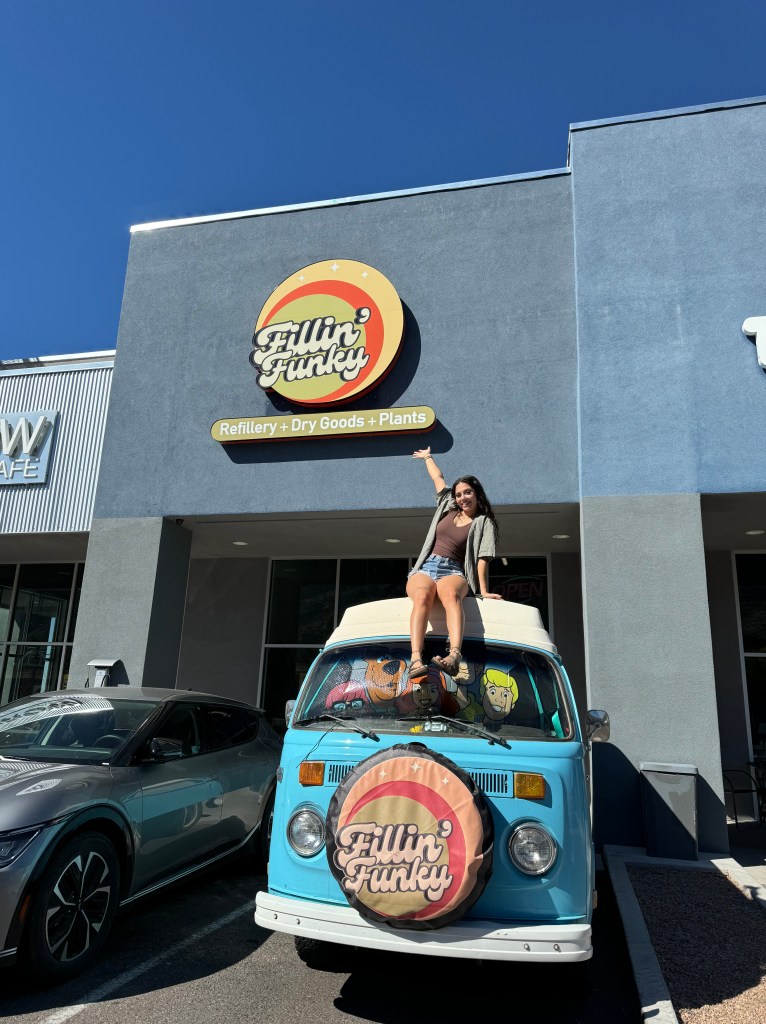
I’m kicking off my Go Local journey with the place where my love for Albuquerque’s local business scene began. Fillin’ Funky Refillery! Maybe it’s cheating a bit, because I am a regular volunteer there and it’s very near and dear to my heart- but my blog, my rules!
Welcome to the Jungle
I first landed in Albuquerque after three days of driving cross-country with all my worldly possessions, two cranky cats, and a nasty cold. After three more days in bed, slowly adapting to the altitude, I did the natural first thing in a new place- I went for tacos. Afterwards I was stumbling around outside and a sign caught my eye.
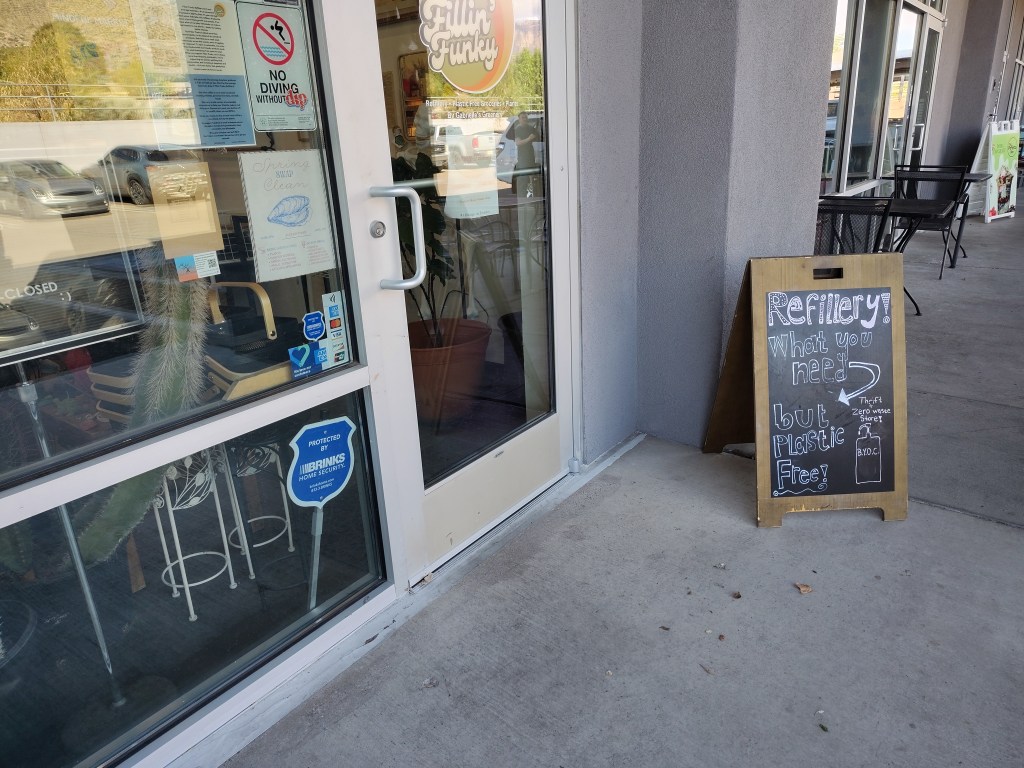
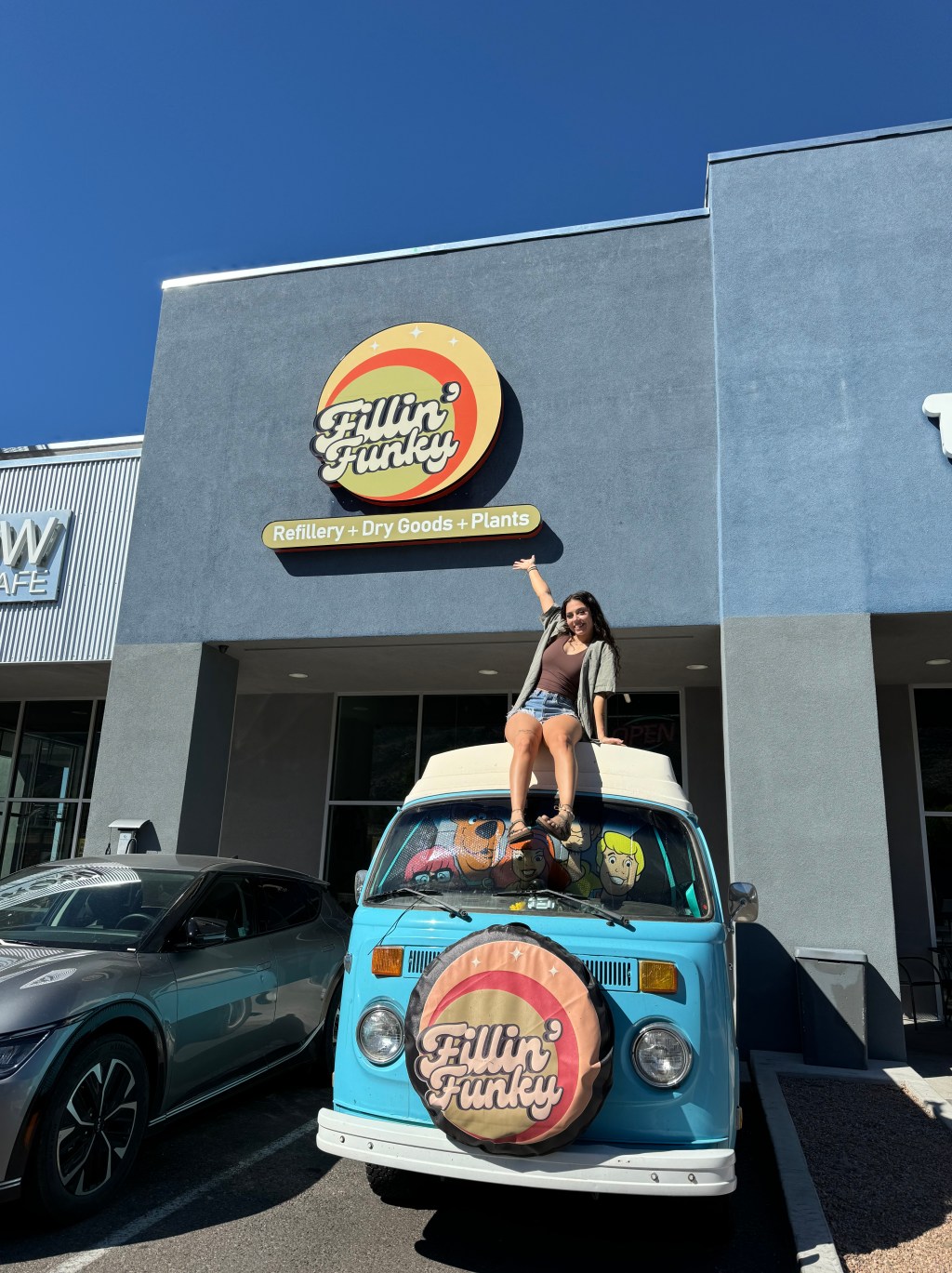
If you can’t read the image above, the sign says “Refillery! What you need, but Plastic Free!”. I was intrigued and stepped inside. I met Gabi, who quickly became my first new friend in Albuquerque.
Inside she has a cornucopia of sustainable goods, nestled between decorations stolen from her home and many cozy plants. On the shelves I saw, literally, things like shampoo and conditioner bars, refillable hand soaps, laundry soap bars, natural cleaning supplies, bulk beans and rice, Italian pastas and olive oils, and more. Figuratively, I saw an easier way to live more sustainably. I was immediately obsessed and have been a regular behind the counter ever since. If you come in, you just might catch me and my little one chatting with Gabi or talking up the shampoo bars!
I saw an easier way to live more sustainably.
-PeachyKeen (yes I’m quoting myself)
Gabi’s Journey
So how did Gabi get behind the counter where I found her? It started in the 6th grade, when her class learned about the Great Pacific Garbage Patch. “I knew I wanted to be part of the change somehow. That was the root, I wanted to help the environment.”

She slowly started investigating changes she could make in her own life to be more sustainable, like bringing her own Tupperware to restaurants for leftovers. Nothing crazy, but little things she felt like she could do to lessen her impact on the environment. Then in the 8th grade, she discovered a video of a refillery in New York. She thought, “I can’t wait for one to be opened in New Mexico for me to walk to and get everything I need refilled!”.
Little did she know at the time she would be doing it herself! COVID hit when she was still in high school. Instead of lying anxiously on the couch like the rest of us, she decided to put everything she had into starting a sustainable refillery at the ripe old age of 17.
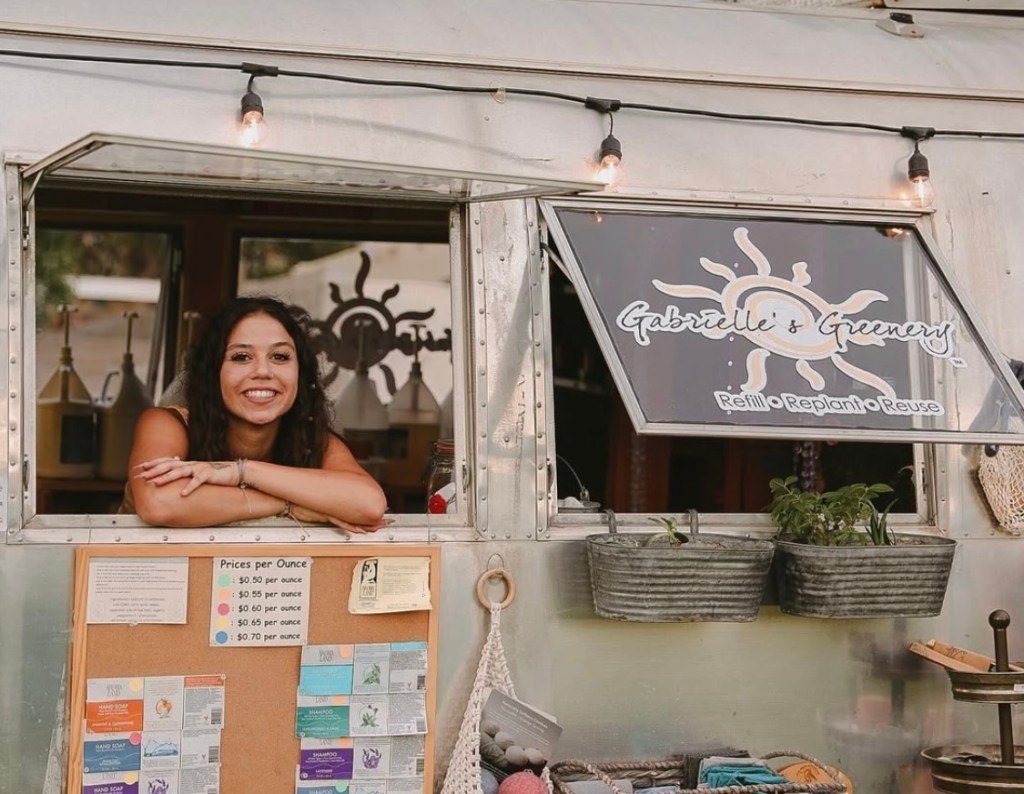
As she got started, she learned about the struggle of small business firsthand and made a decision. She decided to focus on selling only small, well-vetted brands so that as her business grew, they would all grow together. She started by doing pop-ups wherever she could and selling her refillable goods from the back of her Airstream. Two years ago she was able to get a storefront, and recently she was able to celebrate the 5 year anniversary for the whole endeavor.
Let’s talk about Quality
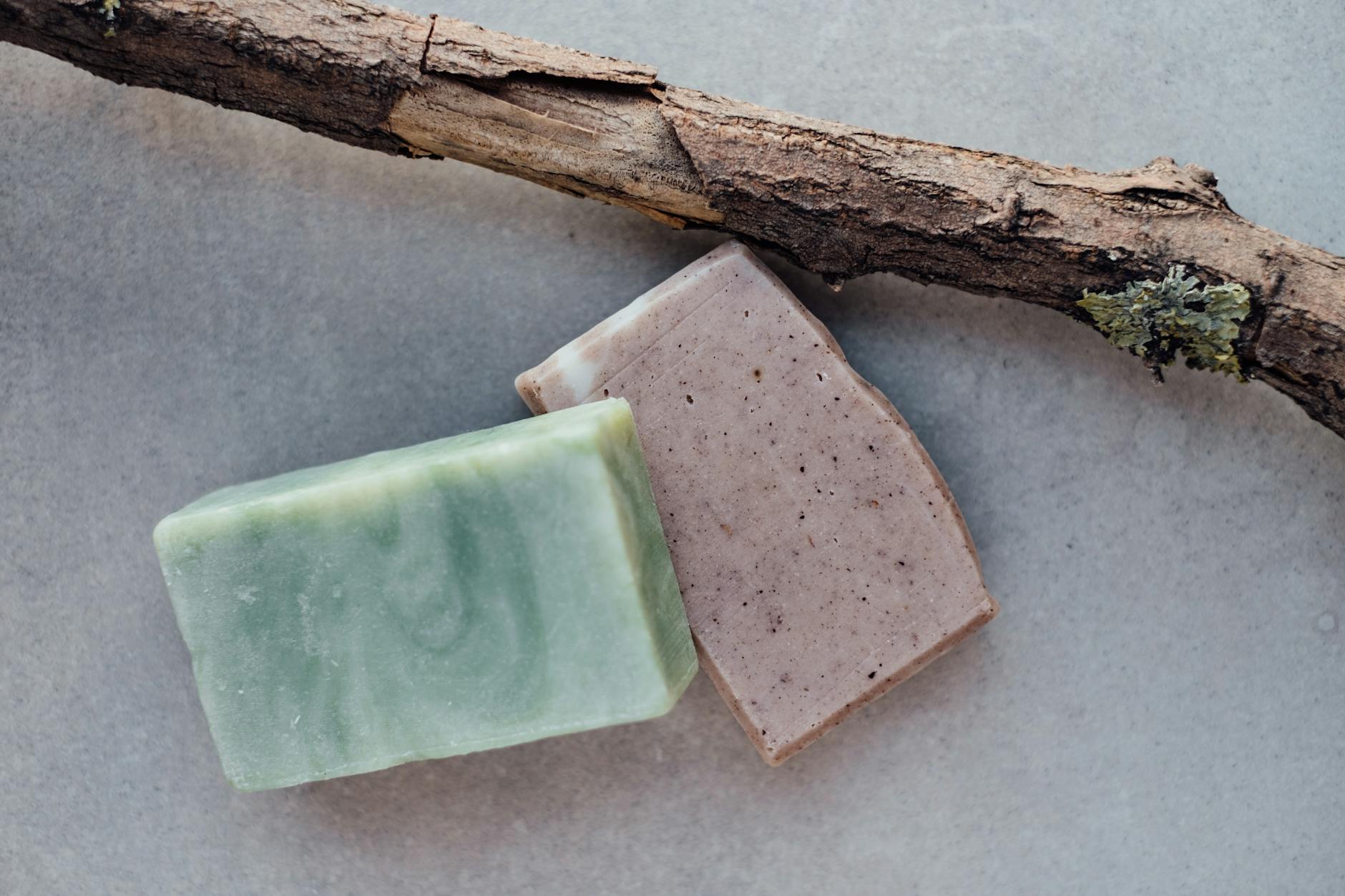
There are lot’s of benefits to the products Gabi stocks, primarily in terms of quality. As an example, Gabi used to think she was allergic to bar soaps. “It was really the major bar soap company I was using” Gabi says. She was hesitant, but eventually tried again with a locally made bar soap and discovered she had zero issues with it. It was a lightbulb moment. “The hippies were right and I realized more natural stuff actually is better for you.”
The hippies were right and I realized more natural stuff actually is better for you.
-Gabi, owner of Fillin’ Funky
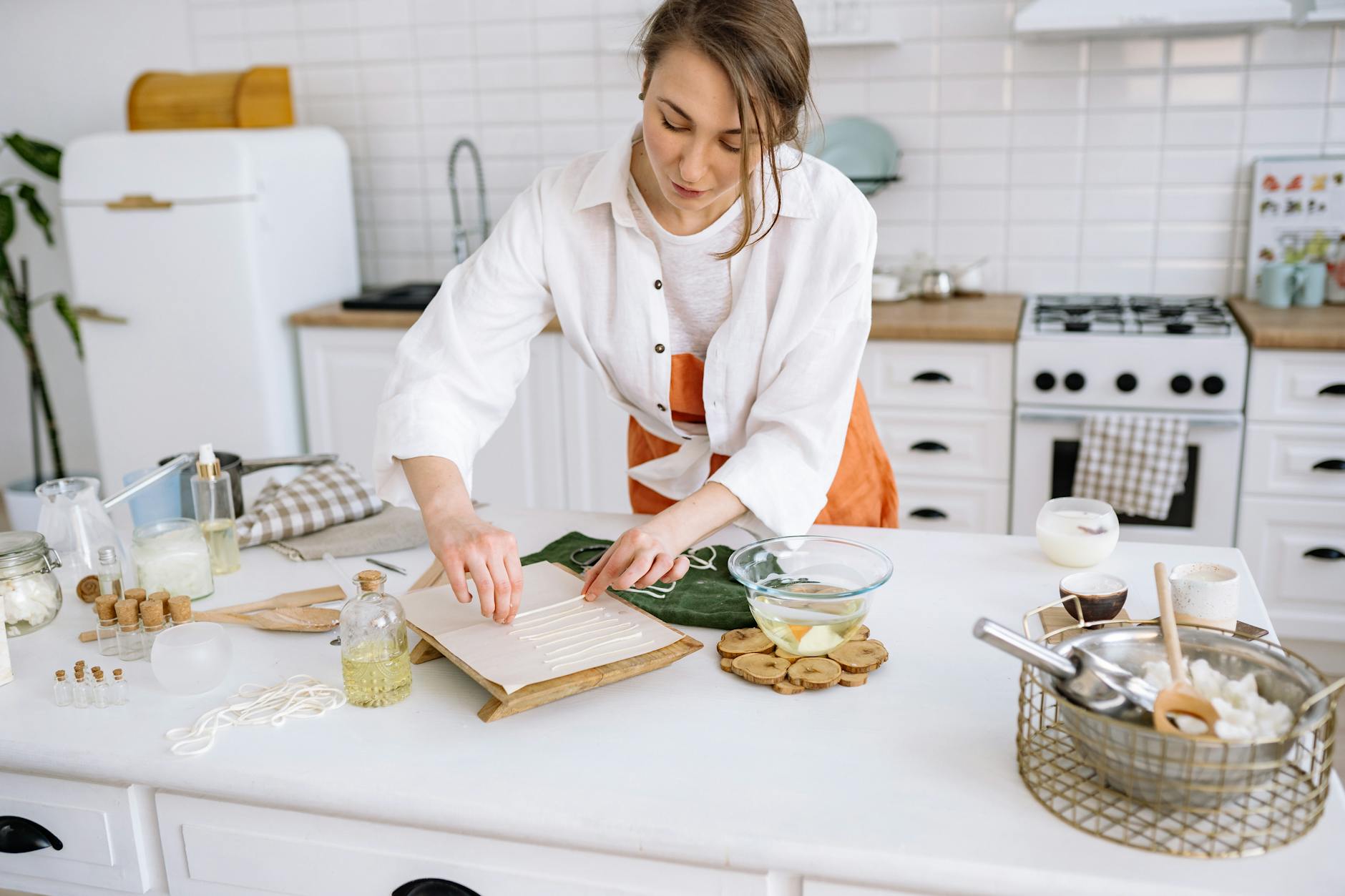
While the term “natural” is broad enough to be all but meaningless (check out the Wikipedia article for “Natural Product” sometime), when we talked about it I understood it to mean products with less and simpler ingredients- the kind of recipes that you could picture a human feasibly cooking up, outside the realms of massive mechanical factory lines.
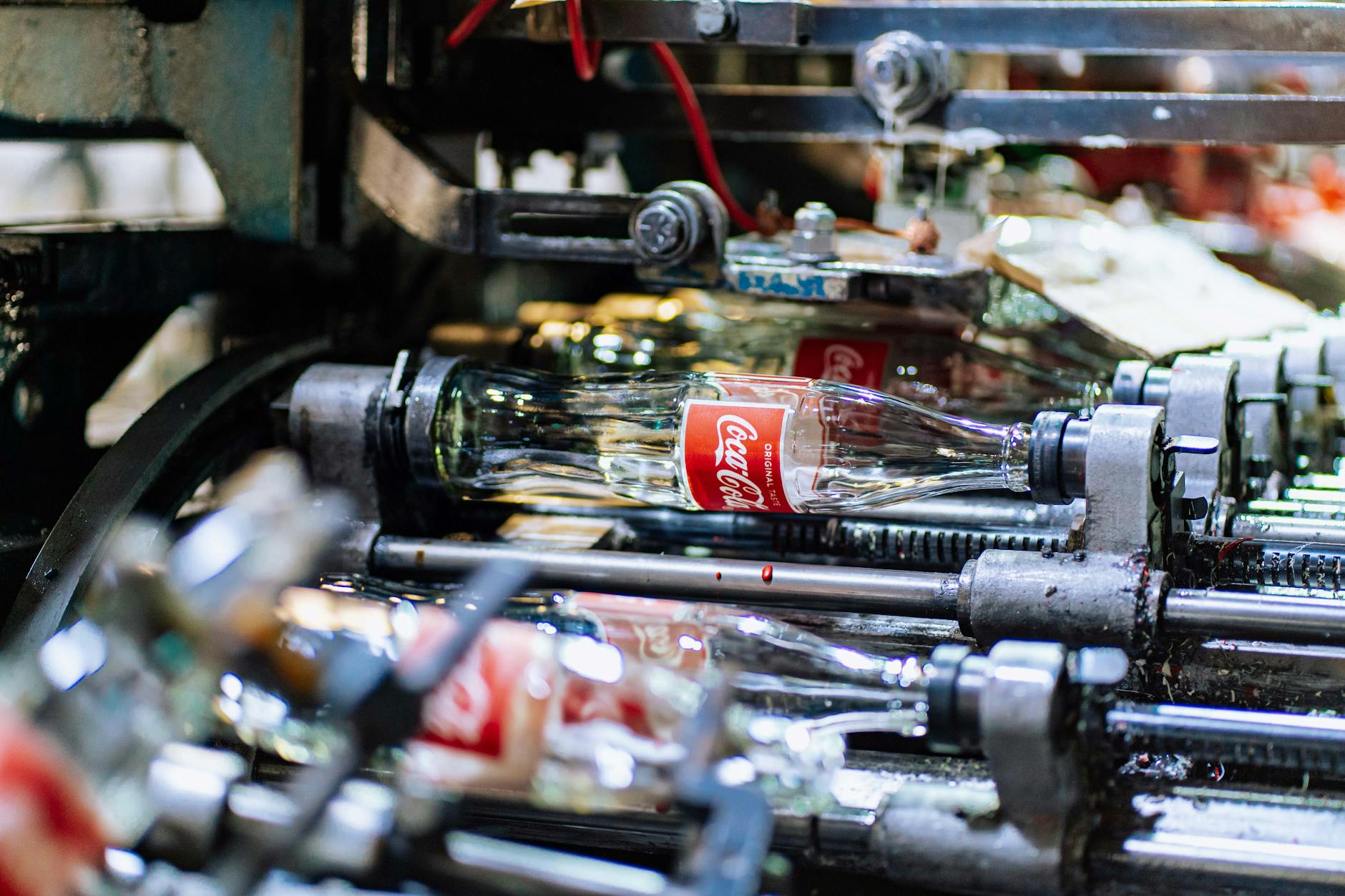
For the record, I’m not saying that a perfect world would have no large scale manufacturing; it’s just not feasible for us all to survive on only hand crafted things. What I’m criticizing here is the overcomplication and degradation of product recipes for the sake of profit.
Consider the terrible example of Hershey’s, which has been in the news lately because the grandson of Mr. Reese himself is displeased with the candy the company is putting out these days. Many of the current Reese’s products can’t legally be called milk chocolate and peanut butter anymore, instead they are eerily marked as “milk chocolate candy” and “peanut butter creme”. Real milk chocolate and peanut butter is expensive apparently, so they are cutting corners by swapping out ingredients.
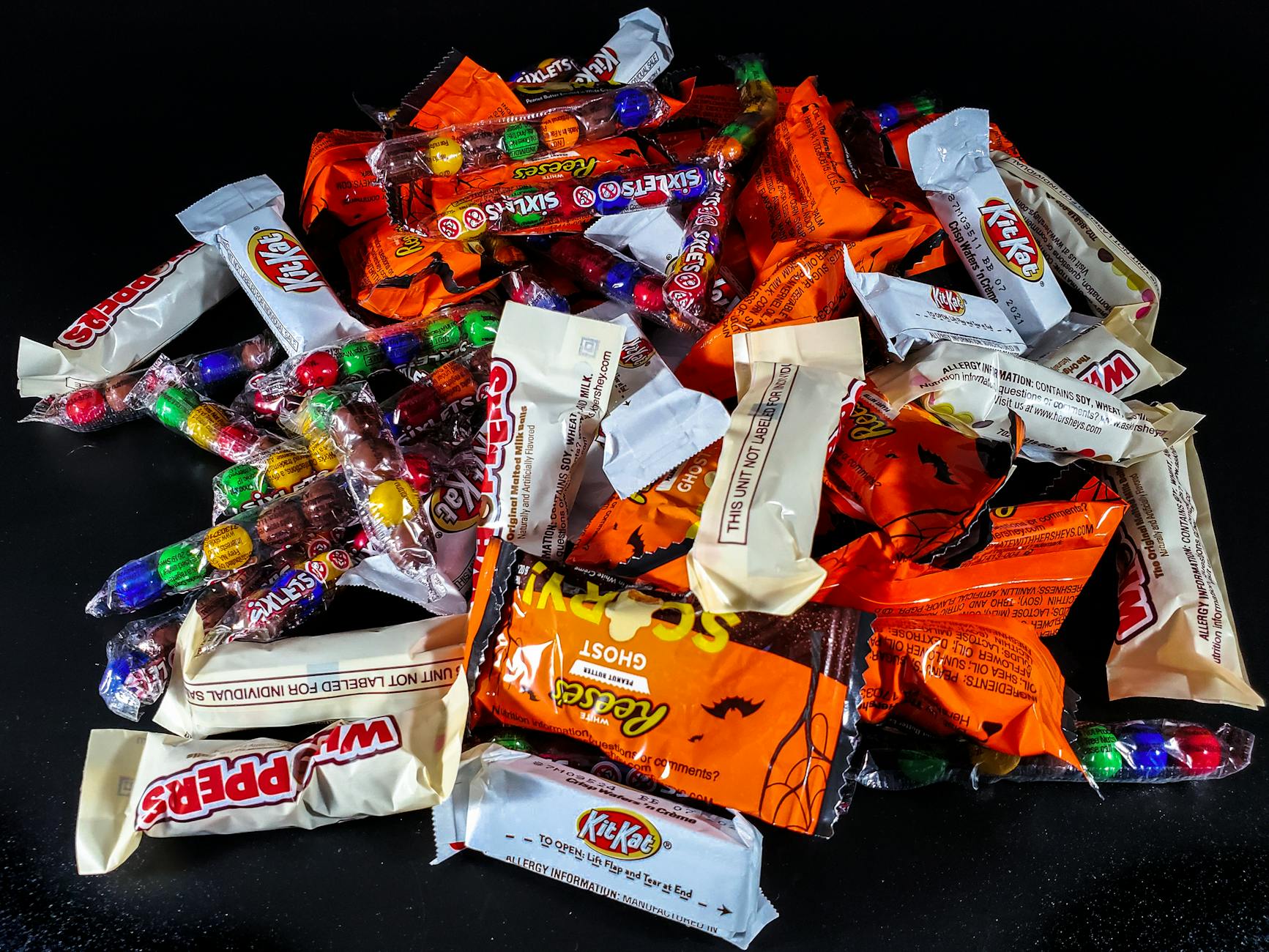
It’s an increasingly common practice corporations are using in their race to the bottom known as “skimpflation”. NPR has a great article on it you can read here. Big business is constantly changing their formula to maximize profits. It’s a nightmare if you happen to be allergic to an unknown ingredient a paragraph deep on the label, like Gabi is.
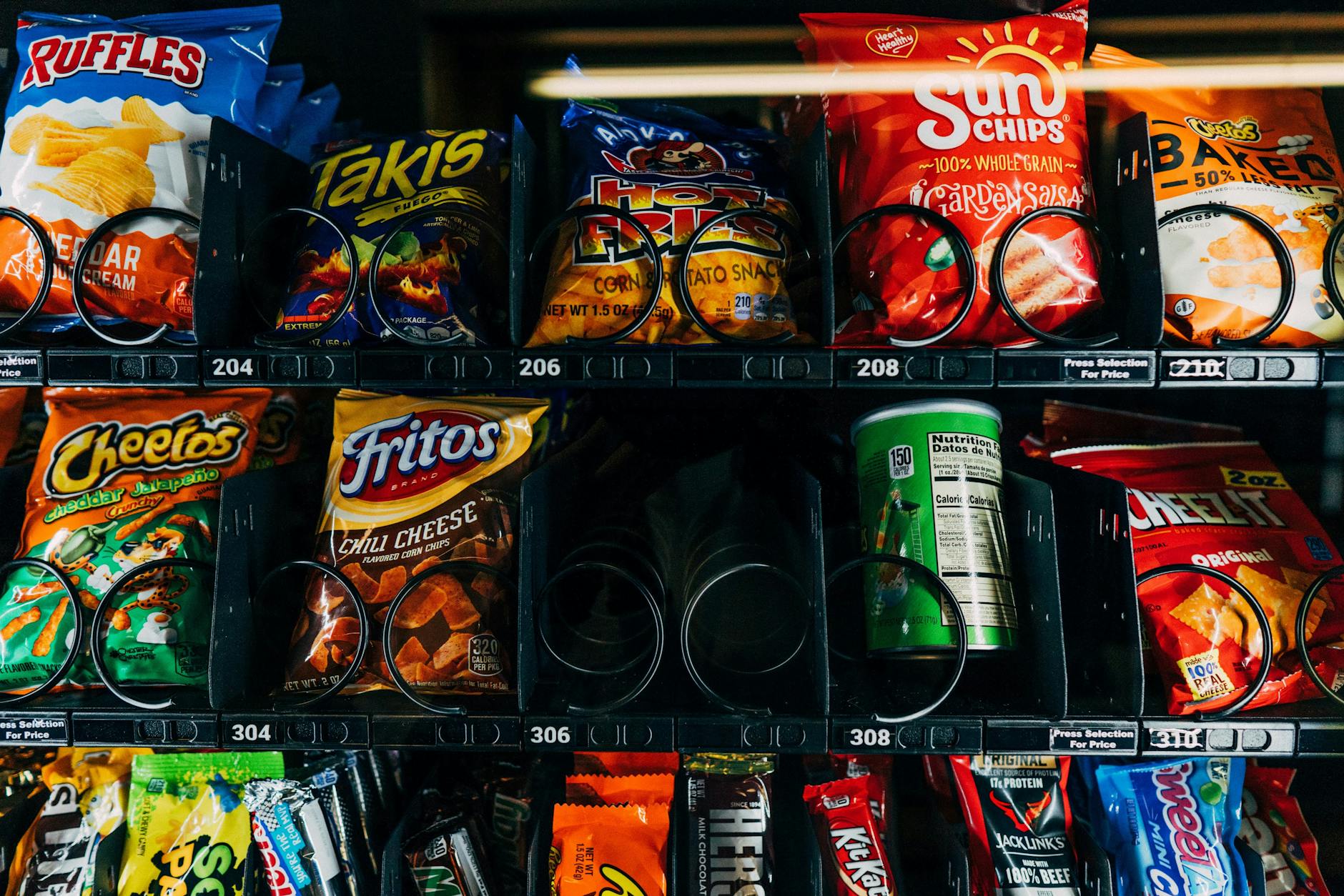
The point is that big business only exists to make money; they don’t really care about our health. One of the things Gabi (and other small/local business owners like her) can offer over the big box stores is that basic level of care. Gabi personally uses as many of her own products as she can and is very selective about the products she chooses to sell. On her self care products, Gabi says “There’s no one size fits all because everyone’s skin, hair, body, everything is so different. But at least I can say I use [the products I sell] because a lot of these big companies don’t even eat their own pudding so to speak.” I wonder, do you think Hershey’s CEO snacks on the peanut butter creme and milk chocolate candy coming off the line? It’s hard for me to picture.
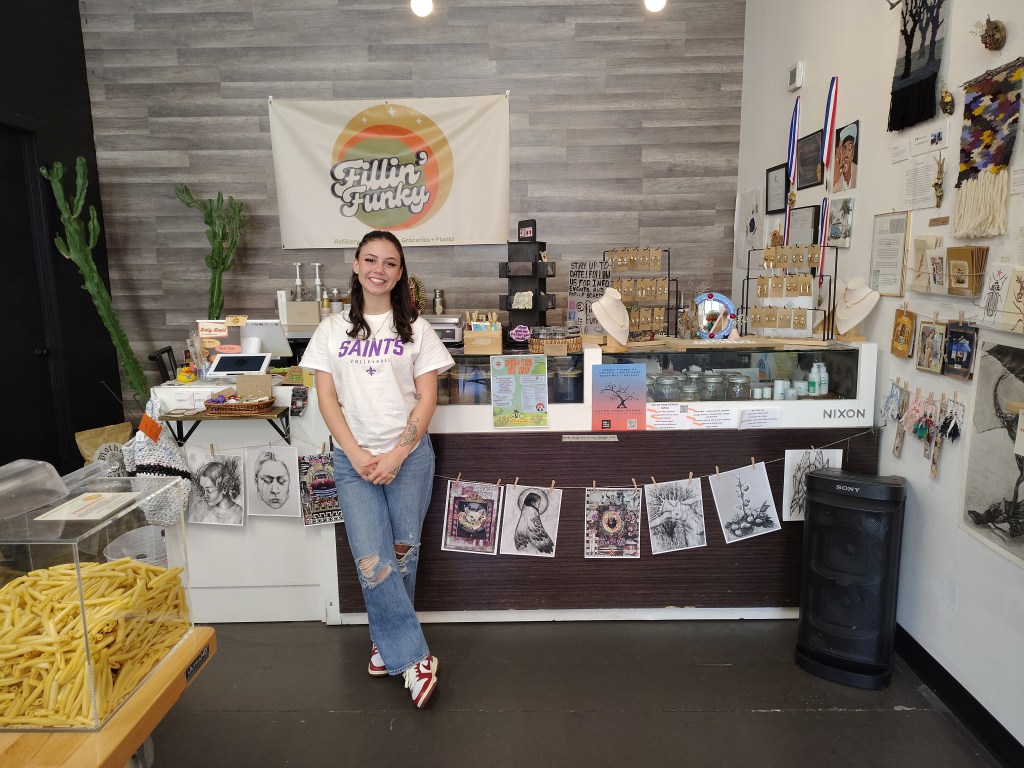
Gabi’s been using her products since the beginning, and the obvious stress of running a small business aside, she says overall the store’s been good for her health. “I have the healthiest hair and skin I’ve ever had in my life.”, says Gabi. Since switching to her soaps, shampoos, and conditioners, I can say the same.
Notes on Affordability
You might be thinking, ‘That sounds lovely, but there’s no way I can afford these fancy options- guess I’m stuck with whatever the cheapest brand at Walmart is…” Well, fret not! As a young person in this economy, Gabi’s very aware of the cost of living and prices things as affordably as she can. When she bought dry goods to sell for the shop, she walked into a Sprouts and intentionally priced her stuff lower. On her refill products, she hasn’t raised prices in 5 years. You can’t say that for your average grocery store. She sources most of her product from in the New Mexico of the U.S., which helps her keep her prices lower than importing product would allow her to.
If you’re skeptical about the affordability, I can understand why. The big box stores can buy in much larger quantities, so they can generally sell cheaper mass-produced products. You might stroll in to Fillin’ Funky and think some of the prices feel really high. But, keep in mind there is a huge difference between the sticker price and the long term price. Sustainable refill products tend to be more highly concentrated and more effective, which means they last longer with the same amount and can do more with less. In practice it means it’s not as expensive as it feels when you are looking at sticker price alone.
As an example, let’s compare laundry soap.
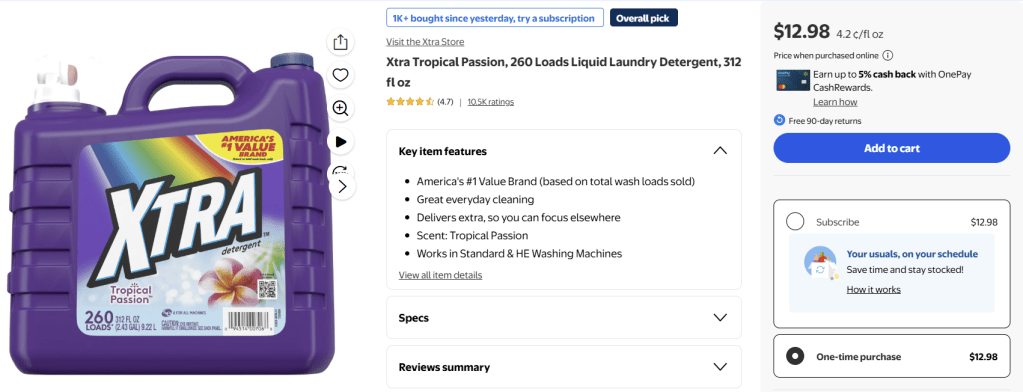
Let’s say you want the cheapest option from Walmart. On their website I’ve found this Xtra Laundry Detergent- 312 fluid ounce (fl oz) for only $12.98 as of April 2026! That’s only 4.2 cents per fl oz in a massive jug.
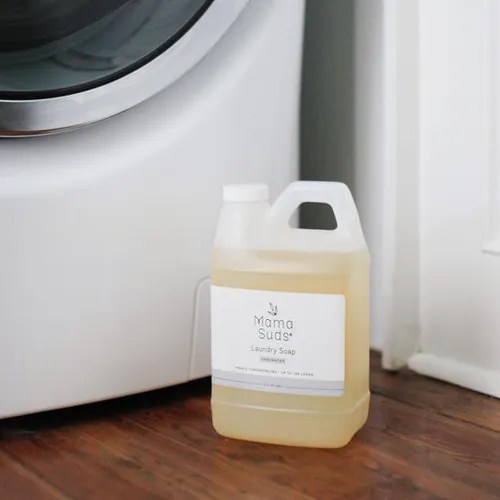
Fillin’ Funky sells MamaSuds Laundry Soap at 45 cents per fl oz. (GASP!!!), MamaSuds cost ten times more! Not so fast.
If you look at the packaging for the Xtra detergent it says that the giant jug will last you 260 “medium” loads (and let’s pretend we actually use the amount they recommend and never accidentally glug extra out of the easy pour nozzle). That’s 1.2 fl oz per load.
For a regular clothing load with MamaSuds, they recommend 1/2 to 1 tablespoon (or a 1/4 to 1/2 fluid oz per load). MamaSuds can do the same job with less than half the amount of soap!
So the real comparison is cost per load. For Xtra detergent- the absolute cheapest option- that’s about 5 cents a load. For MamaSuds, its about 11.3 cents to 22.5 cents. Yes, it’s still 2 to 4 times the cost of Xtra, but consider the cost difference over the course of a year. Assuming you are doing 3 medium loads a week (or 156 a year), Xtra would cost you $7.8 a year and MamaSuds would cost you $17.55-$35.10. At most, that is a $27.30 difference over the course of a year, or an extra $2.28 a month. Is using more sustainable, safer, and quality soap worth an extra two dollars a month? Or the price of crappy takeout once per year? I know for me it is.
The kind of products you can get at a refillery like Fillin’ Funky are not the cheapest option out there, but that’s exactly the point. The cheapest options are cheap because they are made with the cheapest ingredients via the cheapest processes, regardless of the quality. Their formulations are constantly adjusted to reduce the cost of manufacturing (again, creating an allergy nightmare for some folks). Making products that way is obviously not in the best interest of the consumer. If you are willing to consider spending just a bit more to prioritize your long term health and happiness, and support your local community while doing it, I’d say that’s a good investment. If you’re interested in upping the quality of you soap or shampoo or cleaning supplies, just try it- it won’t break the bank.

I’m going to close out today’s post with words of wisdom from Gabi: “Think better and not perfect. Because if you try to think about being sustainable in the most perfect way, you’re going to stress yourself out. Just try to do better, just try.” Because, really, it just feels good to shop in line with your values. You don’t have to do everything, you can start with trying just one thing that really matters to you. In the end, that’s probably the most sustainable approach for us all anyways.
Think better and not perfect. Because if you try to think about being sustainable in the most perfect way, you’re going to stress yourself out. Just try to do better, just try.
-Gabi, owner of Fillin’ Funky
Gabi and I talked about so much more, but I had to call it for this post for brevity’s sake. To hear about the rest we discussed, catch me next time (May 15th) when I write about my interview with Carolyn at People and Planet Refill with a specific emphasis on the social impacts of shopping at your local refillery. In the meantime, check out Fillin’ Funky! It just might change your life for the better. 🙂
Thanks for reading!
-PeachyKeen


Leave a comment